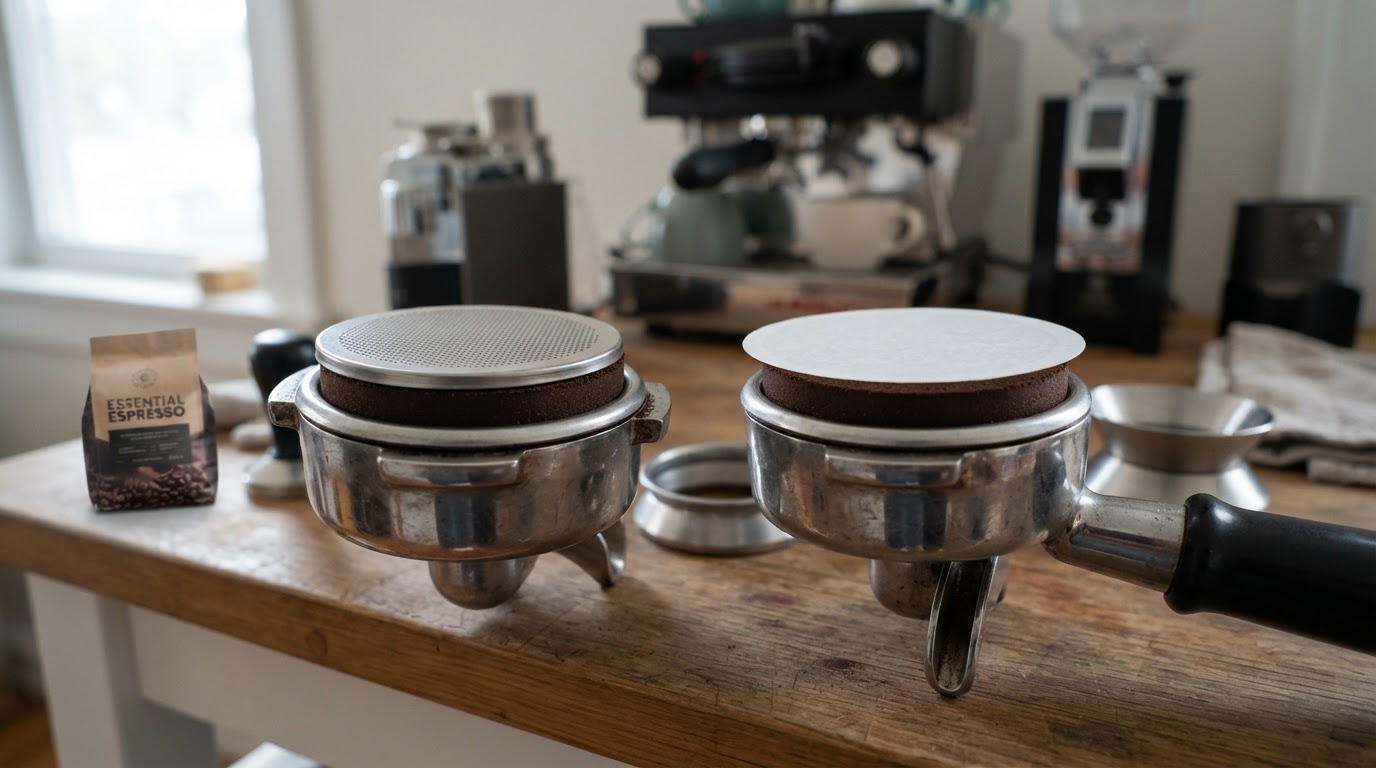
Metal and paper on top: similar placement, different trade-offs
Both accessories rest on the flat surface of a tamped puck, and both are sold as ways to keep the group head cleaner and to shape water delivery. They differ in what they are made of, how much room they occupy, and what you have to do with them after the shot.
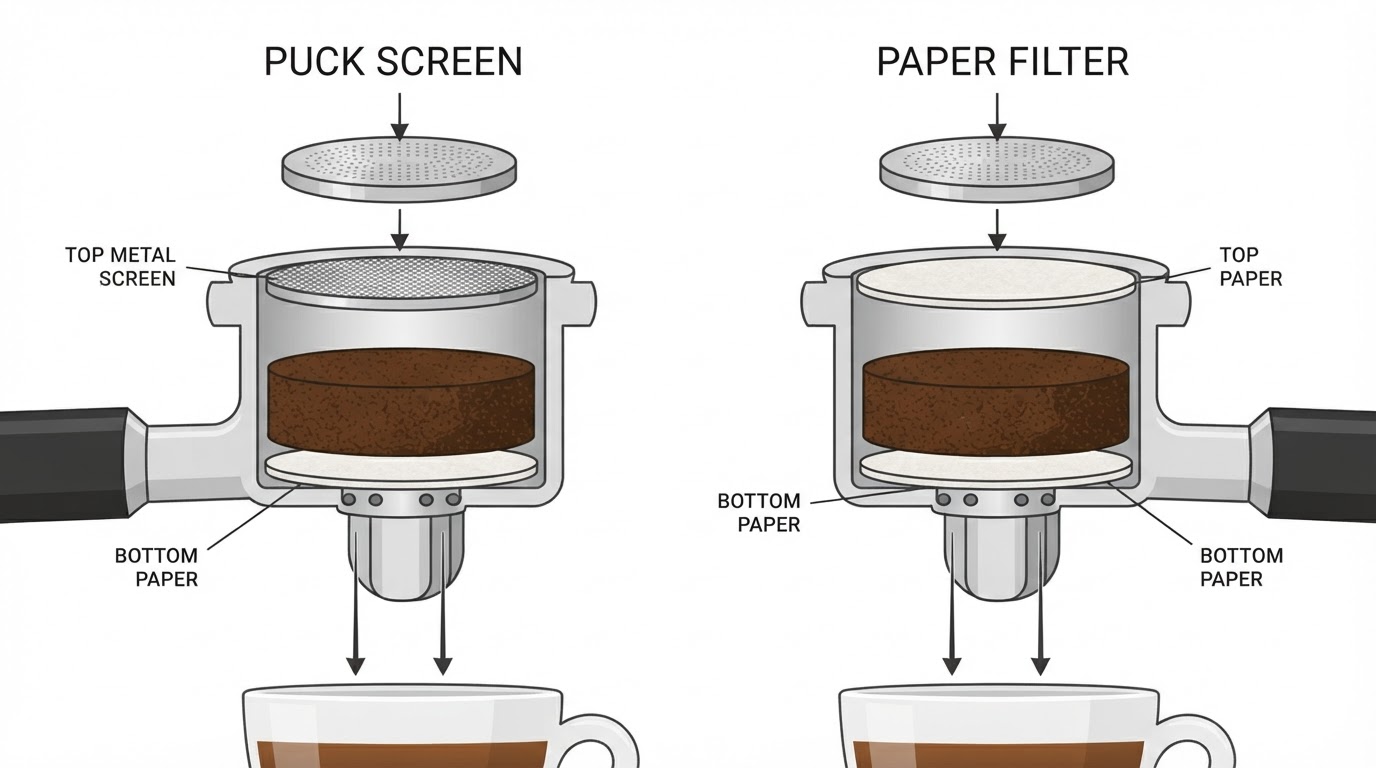
A metal puck screen is a perforated or mesh disc that sits on top of the coffee before you lock in the portafilter. A top paper filter is a thin disc of filter paper in that same position, and it is thrown away after the shot. Nucleus Coffee's 2022 guide, written by Louis-Charles Blais, describes the metal screen as sitting on the tamped coffee, with the mesh retaining oils and grounds that then need cleaning; paper, by contrast, is disposable.
That leaves three practical questions: how much clearance the accessory consumes under the shower screen, whether cleanup means washing or discarding, and how much it changes the water's path into the puck.
Metal on top: separation, dispersion, and a cleaning routine
The mechanical case for a metal screen is simple. It takes the contact with the coffee, so far less ground coffee ends up on the shower screen and in the group. Its mesh also spreads incoming water across a wider area before it reaches the puck surface, which is why the accessory is often discussed alongside even extraction.
The same Nucleus guide gives a material reason mesh screens are common: the woven surface holds oils and fine grounds, which is also why it needs routine cleaning. Rinse the screen after each shot and clean it properly on a regular schedule. Solid stainless discs without mesh are easier to clean, but they lack the mesh surface that spreads water across the puck.
Paper on top: thin separation with little headspace cost
A top paper disc separates the grounds from the shower screen and can help keep the group cleaner, but it does not give you the reusable, water-spreading surface a mesh screen has. It is single-use, so the workflow is open a disc, place it flat, brew, and discard.
Espresso Outlet's guide to paper filters is careful about placement: paper on top separates grounds from the shower screen, while paper underneath changes the interface between the coffee and the basket outlets. The guide is equally clear that neither placement automatically makes espresso better. That is the right frame for this choice — paper is a thin barrier, not a fix for every puck problem.
If your basket is already full at your normal dose, that thinness is the main argument for paper: a top disc takes up very little vertical room, so it is less likely to force a change in dose or grind than a metal disc of noticeable thickness.
Headspace and diameter decide more than the material
Espresso needs clearance between the top of the puck and the shower screen, and the puck swells once it is wet. A metal screen uses part of that clearance, and the amount depends on the actual product: screens vary in thickness, and a basket that clears a thin disc may not clear a thicker one. The honest check is your own machine — confirm the screen sits under the shower screen at the dose you actually use, and choose a thinner screen or a different accessory if it does not. There is no universal dose reduction or fixed screen thickness that fits every basket.
Diameter is the other fit issue, and the nominal number on the label is not a guarantee. Top discs are often sold by nominal basket size, which is why a paper puck screen 58 mm is a common listing for a 58 mm basket, but that number describes the basket's top size. A bottom disc has to match the basket's internal base, which may be narrower, and two baskets sold as 58 mm can still differ at the base. Measure the base rather than assuming the top figure applies. If a disc does not clear the shower screen and sit in the basket without forcing the portafilter, it is the wrong size or thickness for that setup.
Channeling and the problems an accessory will not solve
Channeling is not confined to one spot. Water can take a faster path because of how the bed is built — clumps, uneven density, grind or dose — and also because of how it enters the puck from the shower screen. A top screen or paper disc can change water delivery, and a bottom paper can change the outlet side, but none of them can unclump coffee or correct an uneven bed underneath. If your shots spurt or run unevenly, check distribution, grind, dose and tamp before adding an accessory; these tools do not replace puck preparation or normal machine cleaning.
Broad claims that every stock shower screen is inadequate, or that one accessory eliminates channeling, do not hold up as rules. Many machines deliver acceptable water distribution as they are. These accessories are optional tools with specific benefits.
A wet puck after the shot is another symptom that does not, by itself, justify buying something. If that is what you are trying to solve, start with why a Breville puck can come out wet before adding a screen or disc.
Bottom paper is a separate decision
A bottom paper sits between the coffee and the basket's outlet holes, changing the interface the espresso passes through on its way out and potentially filtering fine particles that would otherwise reach the cup. It is a separate choice from anything placed on top of the puck.
The flow effect is not intuitive. Espresso Outlet's paper-filter guide notes that a bottom filter can make a shot run faster even though water has another material to pass through, and points to Jonathan Gagné's paper-filter experiments as a reason to be cautious about assuming slower flow. Filtering fines can also change texture and perceived clarity; whether that is an improvement depends on the coffee and the drink.
Fit matters more here than with a top disc. The paper has to match the basket's internal base, lie flat without folded edges, and stay in place through dosing and tamping. Use food-contact filter paper intended for coffee, not a household paper towel. Keep dose and target yield fixed for your first comparison, then adjust grind if the shot runs differently.
A practical way to choose
Match the accessory to the problem you actually notice.
Placement | Main job | Headspace cost | Reuse and cleanup | Best fit for |
|---|---|---|---|---|
Metal screen on top | Separates puck from shower screen; spreads incoming water | Higher; thickness varies by screen | Reusable; rinse after each shot and clean the mesh | Brewers who want a reusable barrier and have clearance |
Paper on top | Separates grounds from shower screen | Very low | Single-use; discard after the shot | Baskets with little room to spare |
Paper on bottom | Changes the basket outlet interface; can filter fines | Very low | Single-use; discard after the shot | Filtering fines and cleaner puck release |
Change one thing at a time. Keep dose and yield fixed for the first comparison, pull several shots, and judge flavor, texture, consistency, and cleanup together. Keep the accessory only if it solves a problem you can actually taste or see; the useful espresso puck screen vs paper filter comparison is not about a universal winner but about the position and trade-off that match your basket and your goal.