Start With The Criteria, Not The Shortlist
Most buyer's guides begin with a ranked list and explain the reasoning afterwards. That order is backwards for an appliance you will use every morning for years. Decide what the machine has to do in your kitchen first; the shortlist then becomes much shorter, and the trade-offs become visible rather than surprising.
Drink range
Write down the drinks you actually make in a normal week, not the ones you imagine making. Straight espresso and small milk drinks put different demands on a machine than long blacks or iced lattes. If milk drinks dominate, steam capacity and recovery matter more than subtle differences in brew temperature. If you mostly drink espresso or Americanos, a simpler boiler design can be the better use of your budget.
Milk workflow
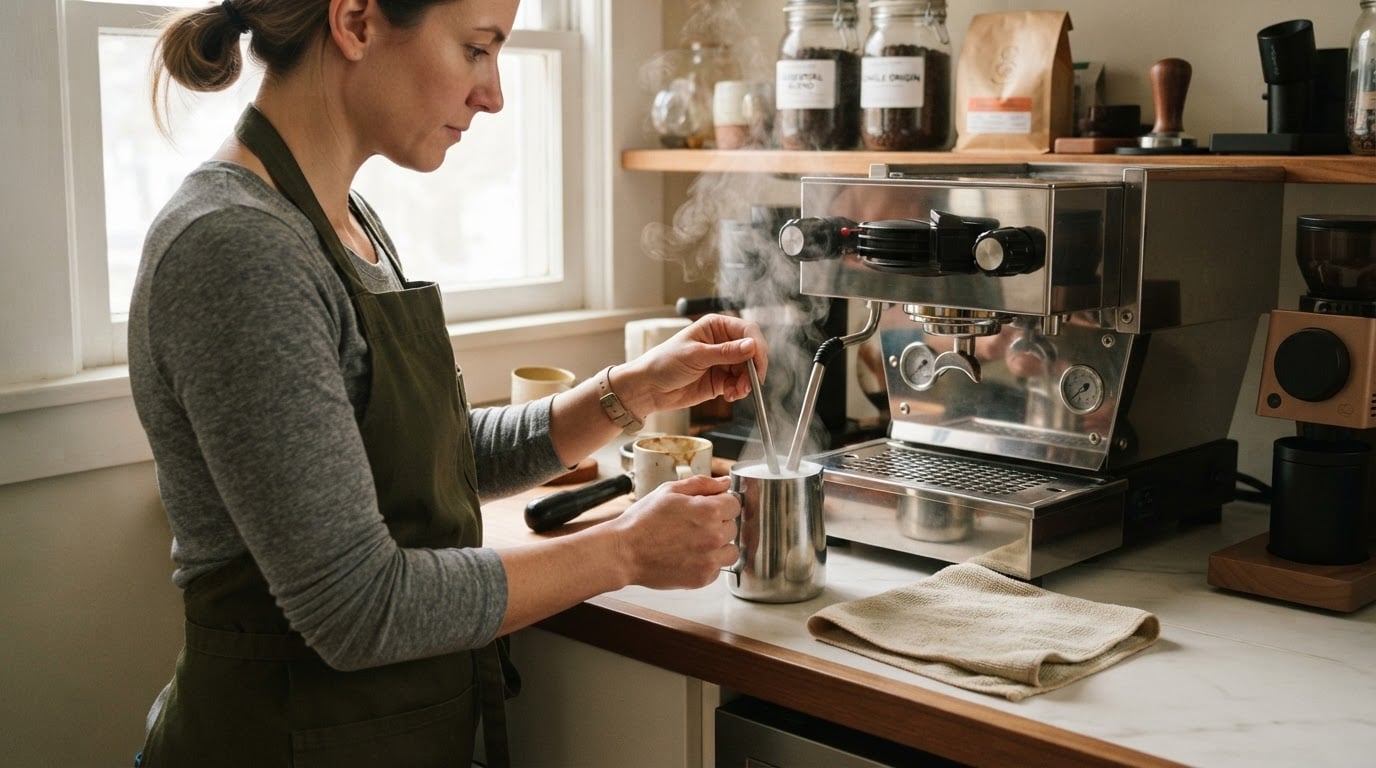
There are four broad approaches: a manual steam wand, an assisted or automatic steam function, a dedicated milk carafe system, and no milk capability at all. A manual wand gives you control and a short cleaning job, but it has a learning curve. Assisted steaming is easier to repeat, yet adds parts that need cleaning. Carafe systems are the most hands-off and usually the most involved to maintain. Match the approach to how many milk drinks you make back to back.
Grinder dependency
Freshly ground coffee is the single largest quality variable in a home espresso setup. A machine with a built-in grinder saves counter space and one decision, but it also locks your grinder choice to that chassis. A separate grinder costs more space and money up front, and gives you an upgrade path later. Whichever route you take, check whether the grinder offers stepless or fine-step adjustment, because small changes in grind are how you fix a shot that runs too fast or too slow.
Counter space and clearance
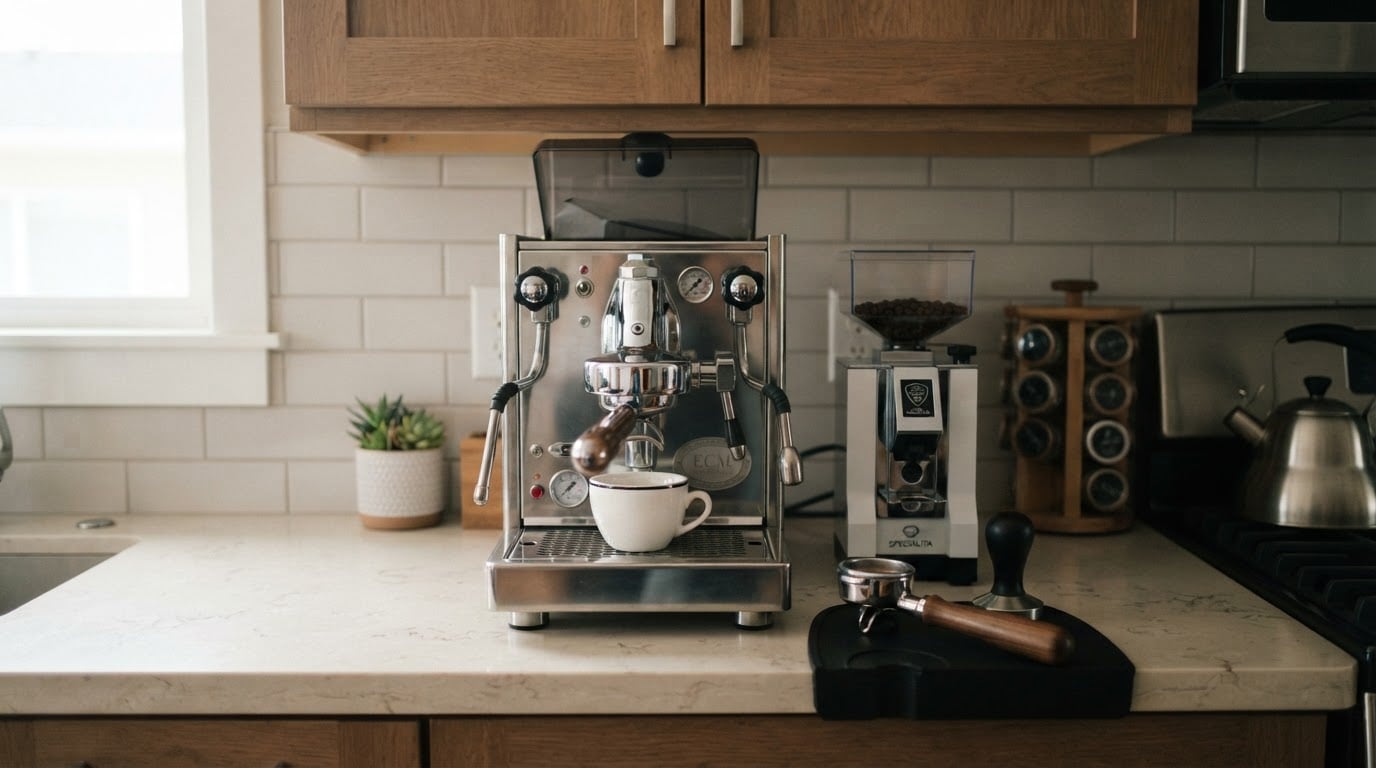
Counter space is a three-part measurement, not one number. Measure the footprint of the machine plus the grinder, the height available under wall cabinets, and the clearance needed to lift the cup onto the drip tray or swing a portafilter into place. Then check how the water tank is accessed: a rear tank needs room to slide the machine forward, a top-fill tank needs overhead clearance, and a front-fill tank is the easiest in a tight kitchen.
Warm-up and daily effort
Warm-up behaviour separates machine designs more than any marketing specification. Thermoblock and thermocoil systems generally reach brewing temperature quickly and suit a household that makes one or two drinks in a hurry. Boiler machines hold a large mass of water at temperature, which is good for back-to-back drinks but usually means a longer wait before the first shot. Also count the daily actions: filling the tank, purging the group, dosing, tamping, steaming and wiping down. A machine that saves money but adds three fussy steps every morning often ends up unused.
Cleaning and descaling burden
Every machine needs water contact surfaces cleaned and descaled, but the workload differs. Manual and semi-automatic machines need a group-head rinse, a drip-tray rinse and periodic backflushing. Machines with milk systems add a milk-path clean that cannot be skipped without sour tastes and hygiene problems. Super-automatics add brew-group rinsing and cleaning cycles. Ask how descaling is triggered, whether it needs proprietary solution, and whether the machine has a water filter option. Hard water shortens every interval.
Long-run cost
The purchase price is only the first cost. Beans, water filters, descaler, replacement gaskets and baskets, milk-system parts and servicing all recur. Pod machines shift much of that cost into each drink. Boiler machines tend to be more repairable, which matters if you plan to keep the machine for a decade. A cheaper machine that needs a separate grinder is not necessarily cheaper overall; add the grinder, a scale, a tamper and a descaling kit before comparing totals.
The Seven Machine Categories That Fit A Home Kitchen
Appliance categories are more useful than brand names when you are still deciding what kind of machine you want, because they describe how brew water and steam are produced and delivered. The categories below cover almost everything sold for home use.
Entry manual and semi-automatic machines
These machines give you a portafilter, a pump and a steam wand, usually with a compact thermoblock heater. They are the least expensive way to learn espresso, and many accept standard accessories so you can improve your technique over time. The honest limitations are temperature stability, modest steam power and, on some models, pressurized baskets that hide grind problems instead of teaching you to fix them. Best for: budget-conscious beginners who want to learn puck prep and are willing to add a separate grinder.
Semi-automatic machines with a built-in grinder
Combining a grinder and a brew group in one chassis solves the two biggest counter-space arguments in home espresso. The workflow is short and self-contained, and there is one power cord, one drip tray and one place to clean. The trade-off is that the grinder is usually the part you would want to upgrade first: check burr type, adjustment range and how easy the chute is to clean. Best for: households that want one compact setup and do not plan to upgrade components separately.
Single-boiler machines with PID control
A single boiler with PID control holds brew temperature within a narrow band and gives you repeatable shots with a simpler design than a dual boiler. The compromise is that the same boiler has to be brought to steaming temperature for milk, so you either pull shots first and steam afterwards, or wait between drinks. Best for: espresso-first drinkers who make milk drinks occasionally and value temperature consistency over speed.
Heat-exchanger machines
A heat exchanger uses a steam boiler with brew water running through a tube inside it, so you can brew and steam at the same time. That makes them a common choice for people who make several milk drinks in a row without moving to a true dual boiler. The cost is complexity: idle temperature is managed with a cooling flush or a thermosiphon design, and the machine rewards you for understanding its rhythm. Best for: households with a milk-drink habit and a willingness to learn the machine's temperature routine.
Dual-boiler machines
Two independent boilers let you set brew and steam temperatures separately and work on both at once. This is the least compromised home design for espresso plus milk, and it is also the largest, heaviest and most expensive category to buy and to service. Check the power requirement and the warm-up time before committing counter space. Best for: daily milk-drink households, small offices and buyers who want the shortest path between two drinks.
Super-automatic machines
A super-automatic grinds, doses, tamps, brews and often froths milk at the press of a button. It is genuinely useful when several people with different skill levels share the machine, and when the priority is speed rather than experimentation. The trade-offs are real: less control over dose and grind, mandatory cleaning cycles, a brew group that needs maintenance, and repair costs that can rival a mid-range machine. Best for: busy households that value convenience over dialling in.
Pod machines
Pod systems remove grinding, dosing and most cleanup from the process, and they produce a consistent result with almost no learning curve. What you give up is control and long-run flexibility: drink range depends on the pod system, ongoing cost sits in every capsule, and you cannot adjust the grind. Best for: low-volume drinkers, guest kitchens and anyone who wants espresso without a workflow.
A quick comparison makes the trade-offs easier to see. Brew-and-steam simultaneity is the clearest dividing line between categories, followed by whether a grinder is included and how much daily cleaning the design demands.
Category | Brew and steam together | Grinder included | Daily effort | Best fit |
|---|---|---|---|---|
Entry manual or semi-automatic | No | No | Moderate, technique-led | Learning on a budget |
Semi-automatic with grinder | No | Yes | Low to moderate | Compact all-in-one setups |
Single boiler with PID | No | No | Moderate | Espresso-first drinkers |
Heat exchanger | Yes | No | Moderate | Milk drinks in sequence |
Dual boiler | Yes, independently | No | Moderate | Daily milk drinks |
Super-automatic | Usually | Yes | Low, cleaning-led | Convenience-first households |
Pod | No | No | Very low | Low-volume drinkers |
A Short Buying Checklist
Run through these checks before you pay, ideally on the manufacturer's own documentation rather than a retailer listing.
- Measure the counter footprint, the height under the cabinets, and the clearance for the cup and portafilter.
- Confirm how the water tank is filled and whether you can reach it in your kitchen layout.
- Decide the grinder plan: built-in, separate now, or separate later. Check adjustment range either way.
- Confirm whether the machine can brew and steam at the same time if you make milk drinks.
- Review how the milk system is cleaned, and how many parts need washing after each use.
- Check the descaling procedure, water filter options, and the water hardness guidance.
- Look for parts availability, warranty terms and whether service is local or return-to-base.
- Verify what is in the box: baskets, tamper, portafilter, milk pitcher, cleaning tablets.
- Compare the current model revision rather than last year's listing.
- Budget for the accessories that make the workflow work: scale, tamper, cups and descaler.
Common Mistakes Buyers Make
- Choosing the machine before deciding on the grinder.
- Paying for milk-drink capability that will be used a few times a month.
- Assuming a built-in grinder is as adjustable as a standalone one.
- Ignoring counter clearance and discovering the tank cannot be removed.
- Skipping the water-hardness question and inheriting a descaling problem.
- Trusting retailer specifications that disagree with the manufacturer's documentation.
- Comparing sticker prices without adding the grinder, scale and consumables.
- Expecting café-style results without consistent puck prep and fresh beans.
What Maintenance Really Involves
Maintenance is best treated as a cycle rather than a list of chores. The exact schedule belongs to your machine's manual, but the shape of the work is predictable.
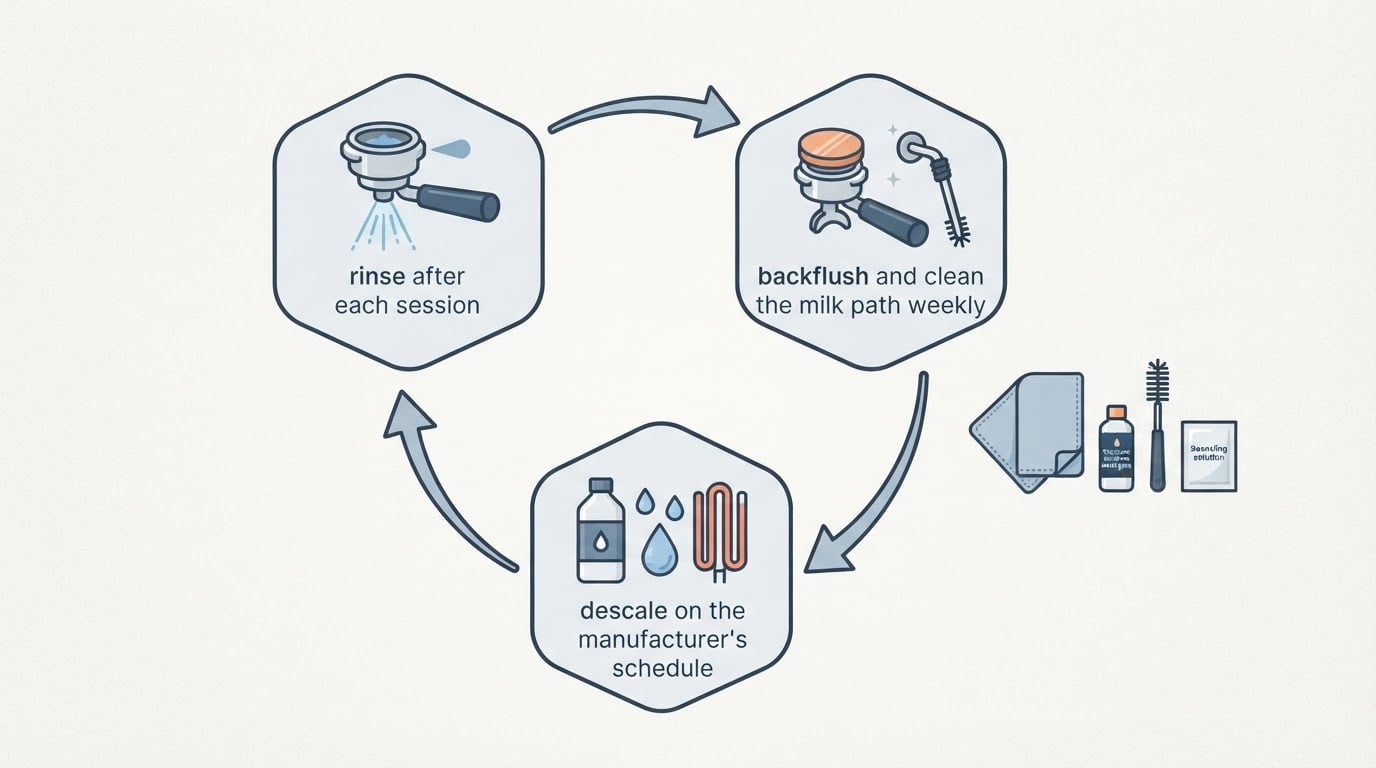
- After each session, rinse the group head, purge the steam wand and empty the drip tray.
- Weekly, backflush if the machine supports it, and clean the milk path thoroughly if you steam milk.
- Periodically, descale on the manufacturer's schedule or sooner if your water is hard.
- Check gaskets, shower screens and baskets for wear, and replace them when shots become inconsistent.
- Keep a small kit: cleaning solution, a brush, a spare gasket and the descaler the manual specifies.
- Use filtered water if your tap water is hard; it reduces descaling frequency and protects the boiler.
FAQ
Is a professional espresso machine sensible for a home kitchen?
Commercial-style machines can work at home if the machine is designed for a reservoir and a standard power supply, but most true café equipment needs plumbing, dedicated power and more space than a home kitchen allows. The practical middle ground is prosumer equipment: heat-exchanger and dual-boiler machines built for home counters.
Should I buy a machine with a built-in grinder or a separate one?
Choose built-in if counter space and simplicity matter most, and you accept that the grinder is part of the same chassis. Choose separate if you want to upgrade the grinder independently or chase more control over grind adjustment. Either way, the grinder determines more of the cup quality than the machine's price tag does.
Are automatic espresso machines worth it at home?
They are worth it when convenience and consistency for several people outweigh control. They are a poor fit if you want to experiment with dose, ratio and grind, or if you dislike routine cleaning cycles. Read the maintenance section of the manual before deciding, not after.
What is the most affordable way into home espresso?
The lowest total cost usually comes from an entry semi-automatic machine paired with a capable hand grinder, plus a scale and a tamper. That combination teaches the variables that matter and can be upgraded piece by piece. Pod systems cost less up front in effort but move the cost into every drink.
How do I compare model years and running changes?
Look for the manufacturer's current specification sheet and check the revision or model code, because running changes often affect the steam valve, basket type or firmware. Retailer listings and older reviews can describe a version that is no longer sold. When a detail is unclear, ask the seller to confirm the exact revision before ordering.
How should I use owner reports and forum threads?
Treat them as a map of failure modes rather than a verdict. Read for repeated complaints about the same part, leaks, steam performance or service experience, and discount one-off reviews. Owner reports are strongest when several people describe the same behaviour on the same model revision.
Which category is best for a beginner?
An entry semi-automatic with a separate grinder teaches the most per dollar, provided you are willing to practise. A semi-automatic with a built-in grinder is the easier start if you want one purchase and one counter footprint. Super-automatics suit beginners who want a button, not a workflow.